

Permanent ink transfer is not an inevitable byproduct of the sterilization cycle; it is a mechanical failure of documentation placement that compromises the integrity of your most valuable assets. You recognize the immediate friction created between the SPD and the OR when a high-value tray is flagged for staining. These marks are more than cosmetic defects. They create physical barriers to effective sterilization and often lead to costly, premature instrument replacement.
Mastering the process of preventing ink stains on instruments requires a shift from reactive cleaning to proactive physical isolation. This guide details the clinical protocols and specialized tools necessary to eliminate ink migration while ensuring full compliance with the latest AAMI standards. We'll analyze the logistical root causes of staining and the specialized solutions, including the Universal Plus Surgical Count Sheet Holder, that provide the necessary barrier to maintain a sterile, professional inventory. By implementing these precise standards, facilities can achieve zero ink transfer and extend the operational lifespan of every surgical tray.
Key Takeaways
- Understand how ink deposits create physical barriers to steam penetration, compromising sterilization efficacy beyond simple cosmetic damage.
- Implement rigorous SOPs for preventing ink stains on instruments, focusing on the use of validated medical-grade pens and strict documentation isolation.
- Identify the primary contamination risks associated with standard printer ink and non-medical markers used during the tray assembly process.
- Utilize the Universal Plus Surgical Count Sheet Holder to provide a physical barrier that eliminates ink transfer and paper particulate migration.
- Achieve compliance with AAMI standards to extend the lifespan of surgical assets and minimize friction between SPD and OR departments.
The Clinical Impact of Ink Stains on Surgical Instruments
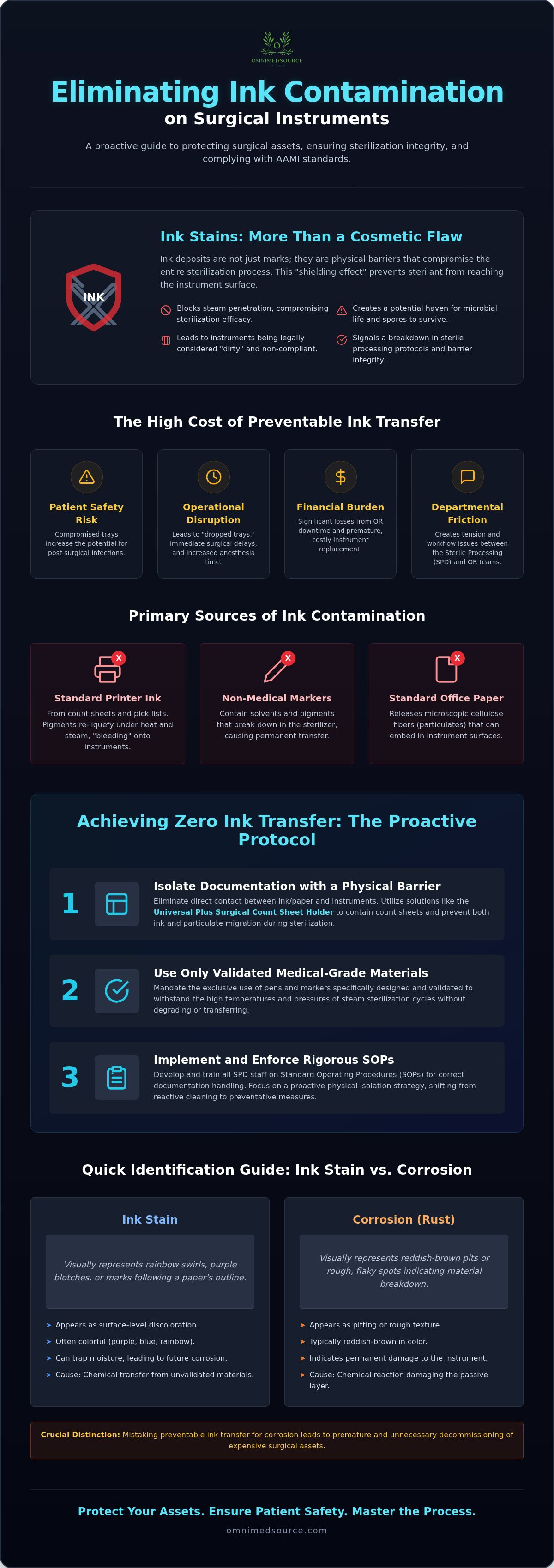
Ink stains on stainless steel are frequently mischaracterized as minor aesthetic flaws. In a high-stakes clinical environment, any foreign substance on the surface of a tool represents a failure in process integrity. These stains are not just "marks"; they are physical deposits of pigments, binders, and solvents. They create a microscopic shield over the metal surface that interferes with the fundamental goal of sterile processing: absolute surface contact with the sterilant. When ink transfers from a count sheet or a non-medical marker onto a device, it compromises the safety of the entire tray.
The Surgical instrument has evolved from simple carbon steel to high-grade stainless alloys specifically to withstand the rigors of heat-based sterilization. However, steam sterilization relies on moisture reaching every square millimeter of the instrument's surface. Ink deposits create a physical barrier that prevents steam from penetrating to the metal underneath. This creates a "shielding" effect where microbial life or spores can survive the cycle, tucked away beneath a layer of dried ink. Consequently, preventing ink stains on instruments is a critical safety protocol rather than a simple housekeeping task.
Beyond the immediate risk of infection, persistent staining serves as a warning sign for broader sterile processing failures. If ink is migrating onto instruments, it indicates that documentation is being handled incorrectly or that unvalidated materials are entering the sterile field. It suggests a breakdown in the barrier between non-sterile documentation and sterile assets, which could eventually lead to more severe contamination issues.
Ink vs. Corrosion: Identifying the Difference
SPD technicians must distinguish between chemical corrosion and simple ink transfer to avoid unnecessary equipment loss. Ink stains often appear as rainbow-colored swirls, purple blotches, or dark patches that follow the outline of a piece of paper. In contrast, oxidation or rust typically presents as reddish-brown pits or rough, flaky spots. While ink doesn't always damage the chromium oxide passive layer immediately, it can trap moisture against the steel, eventually leading to deep pitting. Many departments mistake ink transfer for oxidation, leading to the premature decommissioning of expensive assets.
Patient Safety and Regulatory Compliance
Regulatory standards from AAMI and AORN are clear: instruments must be clean and free of visible soil before sterilization. A stained instrument is legally and clinically considered a "dirty" instrument. If a surgeon or scrub technologist identifies an ink stain in the OR, the entire tray is deemed contaminated. This results in "dropped trays," immediate surgical delays, and the potential for increased anesthesia time for the patient. The financial burden is significant; hospitals lose thousands of dollars in OR time and instrument replacement costs due to preventable documentation errors.
Identifying Common Sources of Ink Contamination in Sterile Processing
While many technicians focus on saline and bioburden as primary staining agents, documentation-related ink remains a persistent threat to instrument longevity. The sources of this contamination are often mundane office supplies that were never intended for the extreme environment of a steam sterilizer. Non-medical grade markers, frequently used for labeling or counting, contain solvents and pigments that break down under heat. Standard printer ink from surgical count sheets and pick lists behaves similarly. When these materials are placed in direct contact with metal, they create a high risk for permanent transfer.
The mechanism of transfer is a physical "bleeding" effect. During the high-pressure steam cycle, the combination of moisture and thermal energy re-liquefies dried pigments. Standardized CDC Sterilizing Practices emphasize the removal of organic debris; however, chemical residues from office supplies often bypass these initial cleaning stages. If documentation sits directly on hot metal surfaces, the ink migrates from the paper into the metal as the stainless steel expands. This results in an etched mark that is difficult to remove without professional refinishing.
The Count Sheet Problem
Surgical count sheets are essential for patient safety, yet they are a primary vector for contamination. Standard office paper releases microscopic cellulose fibers during the sterilization cycle. When these fibers combine with re-liquefied printer toner, they form a sticky residue that adheres to instrument serrations and box locks. A common mistake is placing the count sheet directly on top of the instrument set or tucked under the tray liner. This maximizes the surface area for ink migration and particle shedding. Utilizing a specialized surgical count sheet holder can mitigate these risks by providing a physical barrier between the documentation and the instruments.
Chemical Interactions in the Autoclave
The chemistry inside an autoclave is complex. Boiler chemicals, such as amines used to prevent pipe corrosion, can react with the volatile organic compounds in non-medical inks. This reaction can lead to permanent etching rather than a surface stain. Additionally, residual detergents from the wash cycle may act as surfactants, increasing the solubility of the ink and making it more likely to run. Many markers labeled as "waterproof" are designed for ambient temperatures and fail when exposed to 270°F steam. Only validated, medical-grade markers should be used within the sterile processing workflow to ensure preventing ink stains on instruments remains a consistent priority.
Step-by-Step SOPs for Preventing Ink Transfer During Reprocessing
Standardizing the sterile processing workflow requires eliminating every variable that could compromise instrument integrity. Precision is non-negotiable in the SPD. The first step in preventing ink stains on instruments is the mandatory transition to validated medical-grade marking pens throughout the facility. Standard office markers are a liability. They lack the thermal stability required for high-pressure steam cycles and frequently leach pigments onto stainless steel surfaces. Medical-grade alternatives are specifically formulated to remain stable at 270°F, ensuring that labeling stays on the indicator tape rather than migrating to the surgical set.
A strict "no-contact" rule for paper documentation must be implemented during tray assembly. Count sheets and pick lists should never rest directly against metal instruments or tray liners. Physical isolation is the only reliable method to prevent ink transfer. Additionally, tray loading patterns should be optimized to reduce moisture traps. When sets are overcrowded or documentation is sandwiched between heavy instruments, condensate can pool. This excess moisture facilitates the "bleeding" of printer toner and paper fibers. Standardizing these loading configurations ensures that steam circulates freely and documentation remains dry.
Point-of-Use Documentation Protocols
The prevention process begins in the OR. Perioperative teams must handle count sheets with the same level of care as the instruments themselves. Placing a wet count sheet directly on top of a hot instrument set after a case is a primary cause of permanent staining. OR nurses should ensure that documentation is kept separate from contaminated tools during transport. It's also vital to verify ink compatibility with the specific sterilization method being used. Ink that is stable in an EtO cycle may fail and run during a dynamic-air-removal steam cycle.
Post-Sterilization Inspection Techniques
Consistency in the inspection phase allows for early detection of staining patterns before they lead to instrument failure. Technicians should use lighted magnification to distinguish between purple ink stains and dark mineral spotting caused by poor water quality. If a stain is identified, the instrument must undergo functionality testing to ensure the residue hasn't compromised box locks or serrations. Maintaining a log of recurring staining patterns by tray type helps leadership identify specific printers or marker brands that are failing the sterilization process, allowing for targeted corrective actions.
The Role of Documentation Management in Maintaining Instrument Integrity
Documentation is a regulatory mandate, not a suggestion. While many facilities have transitioned to digital tracking systems, physical count sheets remain the primary safety audit trail in the operating room. They provide immediate, non-powered verification during the final count process. This reliance on paper creates a persistent logistical challenge for sterile processing departments. Standard office paper and standard printer toner are incompatible with the extreme environment of a steam sterilizer. They introduce cellulose fibers and volatile pigments into the sterile field, making documentation management an essential strategy for preventing ink stains on instruments.
The cost of paper particle contamination is often underestimated. During a sterilization cycle, standard paper sheds microscopic lint. These fibers act as carriers for re-liquefied ink, depositing a gritty, pigmented residue into the box locks and serrations of surgical tools. This residue doesn't just stain; it creates friction that can lead to mechanical failure. Transitioning to synthetic or highly specialized medical-grade paper reduces linting, but it doesn't eliminate the risk of ink migration if the paper remains in direct contact with the metal assets.
Standardizing Documentation Supplies
Facilities must standardize the materials allowed inside the sterile processing workflow. Standard office supplies are designed for ambient office temperatures, not the 270°F environment of an autoclave. SPD leadership should mandate the use of low-linting, medical-grade paper and validated ink ribbons for all tray printers. Staff training must emphasize the dangers of "improvised" solutions. Using scrap paper, sticky notes, or unvalidated markers for internal labeling bypasses safety protocols and leads to permanent tray damage. Reliability in the sterile chain depends on using materials tested for thermal stability.
Compliance with AAMI ST79 Guidelines
AAMI ST79 provides specific guidance on documentation placement to ensure sterilant penetration. The standards require that any documentation placed inside the tray must not interfere with the sterilization process. Placing a count sheet directly on top of instruments violates this principle by creating a "blind spot" where steam cannot reach. Best practices involve placing documentation in a manner that maintains the sterile barrier while keeping the records accessible to the scrub team. Modern departments achieve this by using the Universal Plus Surgical Count Sheet Holder, which prioritizes preventing ink stains on instruments through physical separation while remaining fully compliant with AAMI standards. This approach ensures that documentation remains legible and the instruments remain pristine.
Advanced Protection: Isolating Count Sheets with Universal Plus
Eliminating ink transfer requires more than just policy changes; it requires a reliable physical intervention. The UNIVERSAL PLUS SURGICAL COUNT SHEET HOLDER serves as the final, critical link in the sterile processing quality control chain. By providing a dedicated, isolated environment for documentation, this tool removes the variable of direct contact entirely. This isolation is the most effective method for preventing ink stains on instruments during the high-pressure environment of a steam autoclave. It addresses the mechanical failure of documentation placement by ensuring that pigments and paper fibers never touch the surgical steel.
The return on investment for dedicated documentation holders is immediate when compared to the cost of instrument decommissioning. A single specialized surgical tray can represent a six-figure investment for a facility. When ink migrates into the passive layer of stainless steel, it often necessitates professional refinishing or permanent removal from service. These costs, combined with the operational delays of "dropped trays" in the OR, create a significant financial burden. Utilizing the UNIVERSAL PLUS SURGICAL COUNT SHEET HOLDER protects high-value assets and ensures that trays remain in circulation without the risk of ink-related contamination. It integrates seamlessly with the SURGICAL INSTRUMENT MASTER WRAP to provide a comprehensive barrier system for the entire tray assembly.
Design Features of the Universal Plus
The UNIVERSAL PLUS SURGICAL COUNT SHEET HOLDER is engineered for the rigors of the modern SPD. It is constructed from high-grade, heat-resistant materials capable of withstanding repeated autoclave cycles without degrading or releasing secondary contaminants. The secure attachment mechanisms are designed to keep the holder in place throughout transport and sterilization, preventing the documentation from shifting and creating moisture traps. Additionally, the transparent design allows perioperative teams to verify count sheet details immediately upon opening the tray, maintaining efficiency without compromising the sterile field. This visibility is essential for ensuring that preventing ink stains on instruments does not come at the cost of workflow speed.
Implementing a Facility-Wide Solution
OmniMedSource supports national hospital systems by providing reliable procurement and fulfillment services for these essential quality control tools. Transitioning to a standardized holder system requires minimal staff training, as the integration into existing tray assembly workflows is intuitive. The UNIVERSAL PLUS SURGICAL COUNT SHEET HOLDER is a Class I medical device that acts as a physical barrier between ink sources and surgical steel. By adopting this solution, SPD leadership provides their technicians with the tools needed to meet AAMI standards consistently. This proactive approach reduces friction between the SPD and OR, ensuring that every instrument delivered to the sterile field meets the highest standards of cleanliness and integrity.
Securing the Integrity of Your Surgical Assets
Maintaining the integrity of surgical inventory is a continuous process of risk mitigation. Ink migration is not an unavoidable byproduct of sterilization; it is a manageable logistical challenge. By enforcing a strict no-contact rule between documentation and metal, your department can eliminate the primary cause of staining and paper particle contamination. This shift protects your high-value sets and ensures absolute compliance with AAMI standards. Protecting these assets is vital for operational efficiency and patient safety.
Success in the sterile processing department depends on having the right specialized tools. OmniMedSource is a Class I medical device distributor trusted by national hospital systems to provide specialized SPD and OR support. Our solutions are designed to bridge the gap between documentation needs and instrument safety. Preventing ink stains on instruments is achievable through the implementation of validated barriers and medical-grade supplies. Request a quote for Universal Plus Count Sheet Holders at OmniMedSource to standardize your quality control process today. Your commitment to precision ensures that every patient receives care with perfectly maintained instruments.
Frequently Asked Questions
Can I use standard permanent markers to label surgical trays?
No, standard permanent markers are not validated for the high temperatures of an autoclave and should never be used. These office-grade markers contain solvents and pigments that break down at 270°F, causing ink to leach onto stainless steel surfaces. Only medical-grade marking pens are thermally stable enough to remain on indicator tape without migrating to the surgical set during a steam cycle.
Is ink staining on instruments permanent or can it be removed?
Ink stains can become permanent if the pigments etch into the metal's passive layer during high-heat sterilization cycles. While some surface stains can be removed with specialized clinical cleaners, deep migration often requires professional instrument refinishing or total replacement. Focus on preventing ink stains on instruments through physical isolation is the only reliable way to avoid this irreversible tray damage.
How does the Universal Plus holder prevent paper particles in the OR?
The Universal Plus holder acts as a physical barrier that prevents paper documentation from direct contact with the surgical tray. It contains the count sheet within a dedicated enclosure, which stops microscopic cellulose fibers and ink particles from shedding into instrument serrations or box locks. This containment ensures that the surgical field remains free of debris while keeping documentation accessible to the scrub team.
Does steam sterilization increase the risk of ink transfer?
Yes, steam sterilization significantly increases the risk of ink transfer because the combination of moisture and heat re-liquefies dried toner and pigments. Under high pressure, these liquefied substances migrate easily from paper to the expanding metal surfaces of instruments. This "bleeding" effect is a primary cause of documentation-related staining, making physical separation a necessity in every steam cycle.
What is the difference between an ink stain and instrument rust?
Ink stains typically present as flat, purple, or rainbow-colored discolorations that follow the outline of a document. In contrast, instrument rust appears as reddish-brown, flaky, or pitted spots on the metal surface. While ink is a physical deposit that blocks sterilization, rust is a chemical reaction indicating active corrosion that compromises the structural integrity of the surgical tool.
Are there specific AAMI standards for count sheet placement?
AAMI ST79 standards mandate that any documentation placed inside a sterile package must not interfere with the sterilization process or the penetration of the sterilant. Placing a count sheet directly on instruments creates a "shielding" effect where steam cannot reach the metal. Using a specialized count sheet holder ensures compliance by maintaining documentation visibility without creating a barrier to effective sterilization.
Can count sheet holders be reused across multiple sterilization cycles?
Yes, high-quality count sheet holders like the Universal Plus are specifically designed for repeated autoclave cycles. They are constructed from durable, heat-resistant materials that maintain their structural integrity through hundreds of high-pressure steam exposures. This durability provides a cost-effective and sustainable solution for preventing ink stains on instruments across the entire lifespan of a surgical tray.
Why is saline more dangerous for instruments than ink?
Saline is more dangerous because it contains chloride ions that cause rapid, aggressive pitting and chemical corrosion of stainless steel. While ink creates a physical barrier to sterilization and causes aesthetic damage, saline chemically destroys the metal's protective passive layer almost immediately. Both substances must be strictly managed, but saline represents a more immediate threat to the mechanical safety of the instrument.
